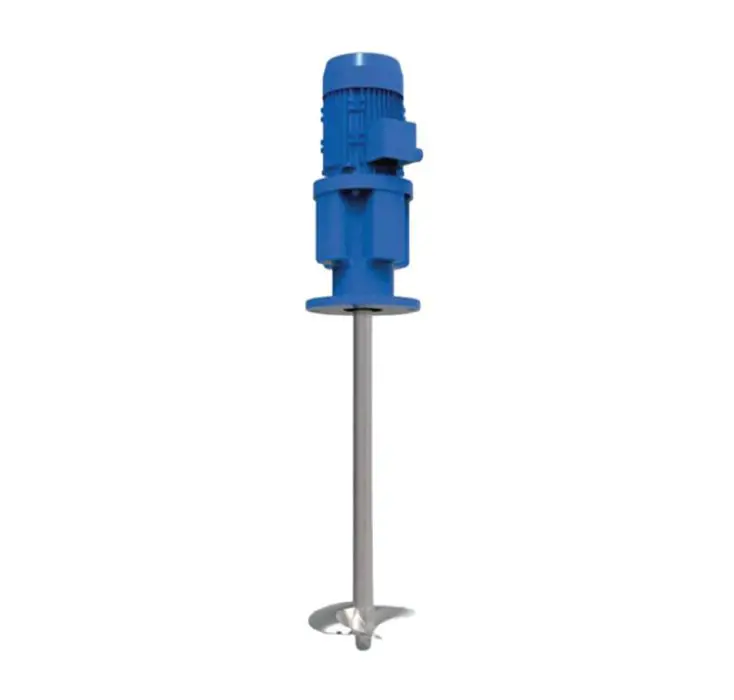
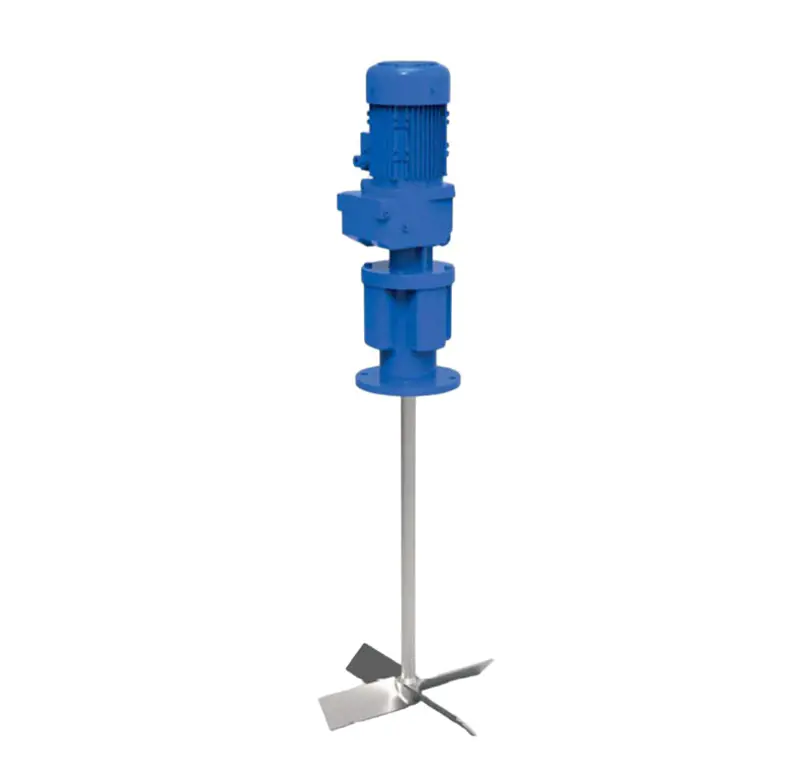
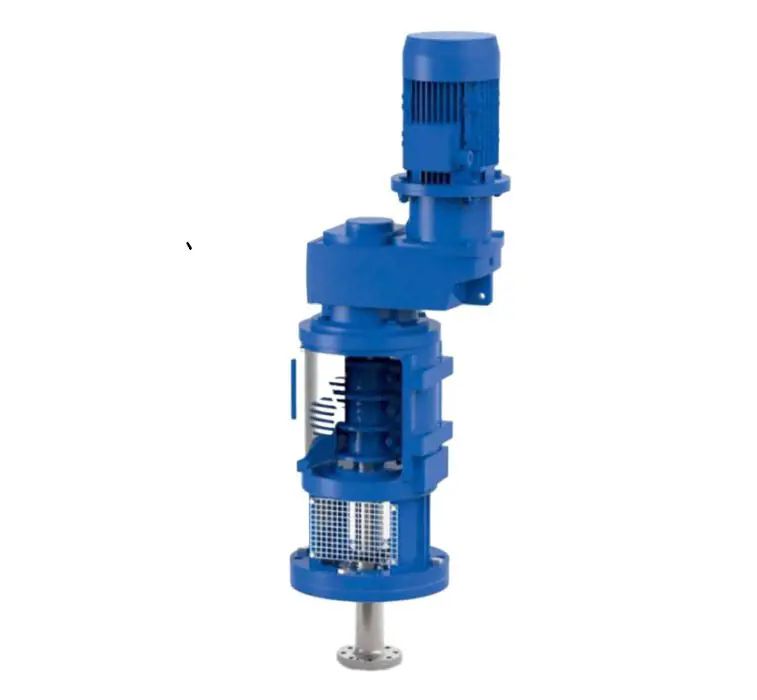
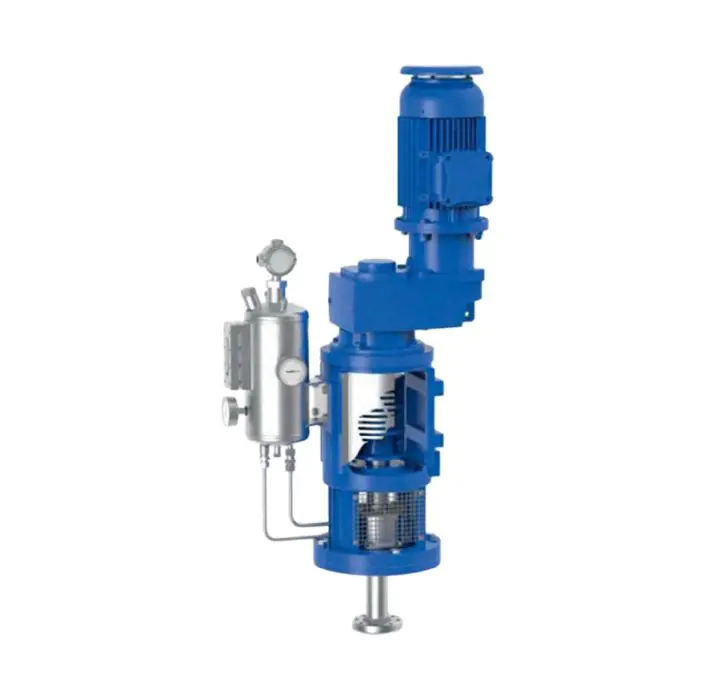
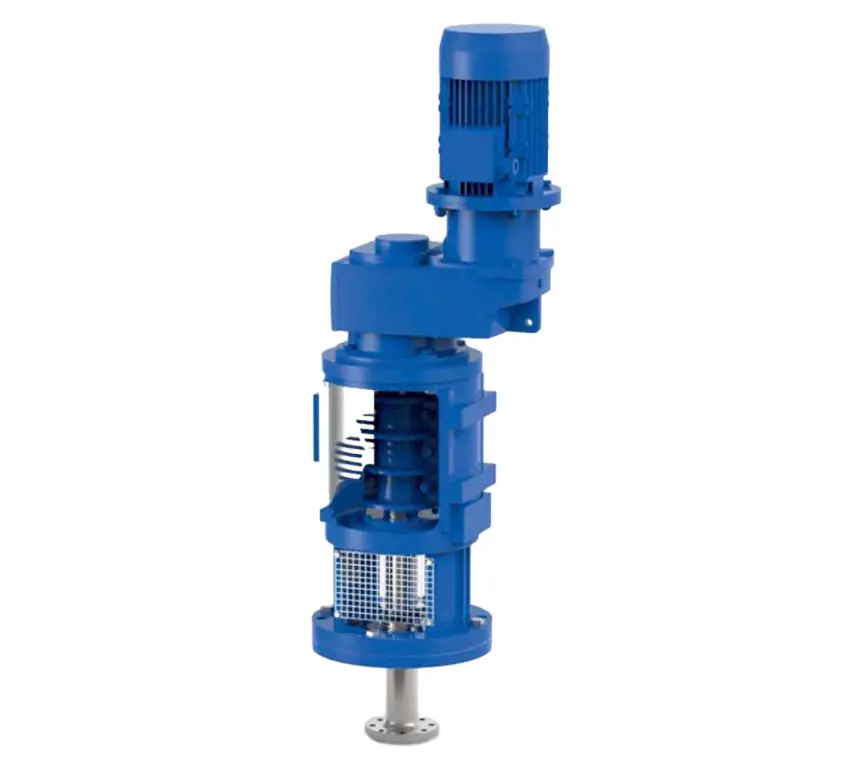
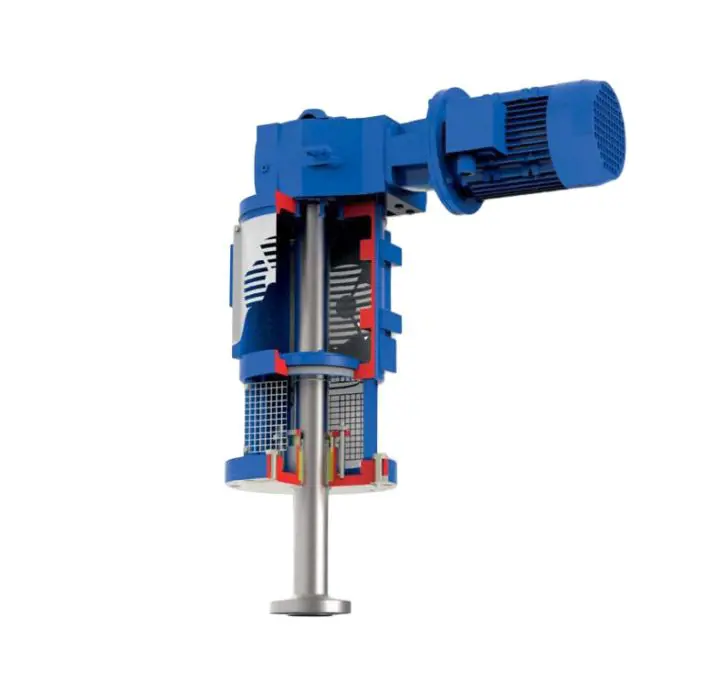
Vertical agitators are the most widely used configuration in industrial mixing processes. Top-entry installation allows the shaft to be positioned on-axis or slightly off-center relative to the fluid centroid, generating predictable flow patterns that can be readily sized to meet the required process outcome.
In the Interpump Process Technology range, vertical agitators cover a broad application spectrum: from simple homogenization of low-viscosity liquids in small tanks, to heavy-duty processing of large volumes with viscous or multi-phase products. The flexibility of the vertical configuration allows the machine to be tailored to process requirements by acting on three main elements: drive type, impeller geometry and construction material.
How a vertical agitator works
The vertical agitator transfers mechanical energy to the fluid through an impeller mounted on the lower end of a rotating shaft. The shaft is connected to a motor — directly or through a gear reducer, installed on the upper flange outside the tank. Impeller rotation generates a motion field that depends on three factors: impeller type, rotation speed, and shaft position relative to tank geometry.
Axial impellers, such as marine propellers or pitched-blade turbines, generate predominantly vertical flow: the fluid is driven toward the tank bottom and rises along the walls, creating complete recirculation.
Radial impellers, such as flat-blade turbines, discharge the fluid horizontally toward the walls, generating two recirculation loops above and below the impeller. Impeller type determines process effectiveness: homogenization, solid suspension, gas-liquid dispersion or heat transfer require different flow patterns.
For viscous fluids or to reduce vortex formation in unbaffled tanks, the shaft can be installed in an off-center or angled position. In large-diameter tanks, multi-impeller configurations on the same shaft are sometimes adopted, with impellers spaced to cover the full fluid height.
When to select a vertical agitator
The vertical agitator is the reference choice when the tank allows top-entry installation and the process requires configuration flexibility that other architectures do not offer. It is particularly indicated when the volume to be processed is within the range manageable by a single agitator, when the tank geometry is cylindrical with a non-extreme height/diameter ratio, and when the process requires precise control of the flow pattern — a characteristic that the vertical configuration delivers better than a side entry.
Compared to side entry agitators, the vertical configuration offers greater impeller flexibility and better mixing control, but requires installation space above the tank and an adequate support structure. Compared to magnetic drive agitators, it delivers higher power ratings and a broader size range, but does not eliminate the mechanical seal on the shaft. Selection between configurations therefore depends on balancing process requirements, installation constraints and sealing needs.