

Industrial Agitators
Side Entry Agitators
Mixing of large volumes with tank wall installation
Side entry agitators are designed to be installed on the tank wall, typically in an angled position relative to the vertical axis, in order to generate a rotational flow field that involves the entire fluid volume. This construction configuration addresses a specific need: agitating large storage tanks where the installation of a vertical agitator is not feasible due to structural, access or roof geometry constraints.
The Interpump Process Technology range of side entry agitators is sized for applications ranging from medium-sized process tanks up to the large storage tanks of the petroleum industry, with a focus on energy efficiency and the ability to keep substantial volumes in motion with a limited number of installed units.
How a side entry agitator works
The side entry agitator is a rotating machine installed on the tank wall through a coupling flange. The motor — directly or through a gear reducer — transmits the motion to a short shaft carrying an impeller submerged in the fluid a few tens of centimeters from the inner wall. The impeller, typically a high-efficiency axial type, discharges the fluid horizontally, generating a jet that propagates through the tank volume.
The angled orientation of the shaft relative to the tank diameter is a fundamental design element. By tilting the shaft a few degrees off the line passing through the tank center, the jet generated by the impeller does not point directly at the center but is slightly offset. This produces a rotational motion of the fluid around the vertical axis of the tank, in addition to the translational motion of the jet: the result is complete product circulation, even in volumes that a vertical agitator would struggle to cover with the same energy efficiency.
For large-diameter tanks — typically those in oil & gas with diameters of tens of meters — the standard configuration involves installing multiple side entry agitators distributed along the perimeter, with coordinated orientation to generate a unified rotational motion. The mechanical seal on the shaft is sized according to tank operating pressure and fluid characteristics.
These agitators are equipped with a mechanical seal that can be single or double lubricated, depending on the product and application. Our Shut-Off system allows maintenance and seal replacement to be carried out easily without the need to drain the tank.
When to select a side entry agitator
The side entry agitator is the reference choice for large storage tanks where top installation is not possible or not efficient. Three typical situations justify this configuration: floating-roof tanks, where no fixed upper flange exists to install a vertical agitator; large-diameter tanks, where a vertical agitator would require disproportionate power and size to move the entire volume; tanks where lateral accessibility is preferable for maintenance reasons.
Compared to vertical agitators, the side entry offers significantly lower energy consumption at equal volume moved and lends itself better to multiple coordinated installations. In exchange, it offers more limited impeller flexibility and less precise control of the flow pattern, factors that make it less suitable for processes requiring specific mixing patterns. Compared to magnetic drive agitators, the side entry handles incomparably larger volumes and power ratings, but does not eliminate the mechanical seal on the shaft.
Related Products

No products
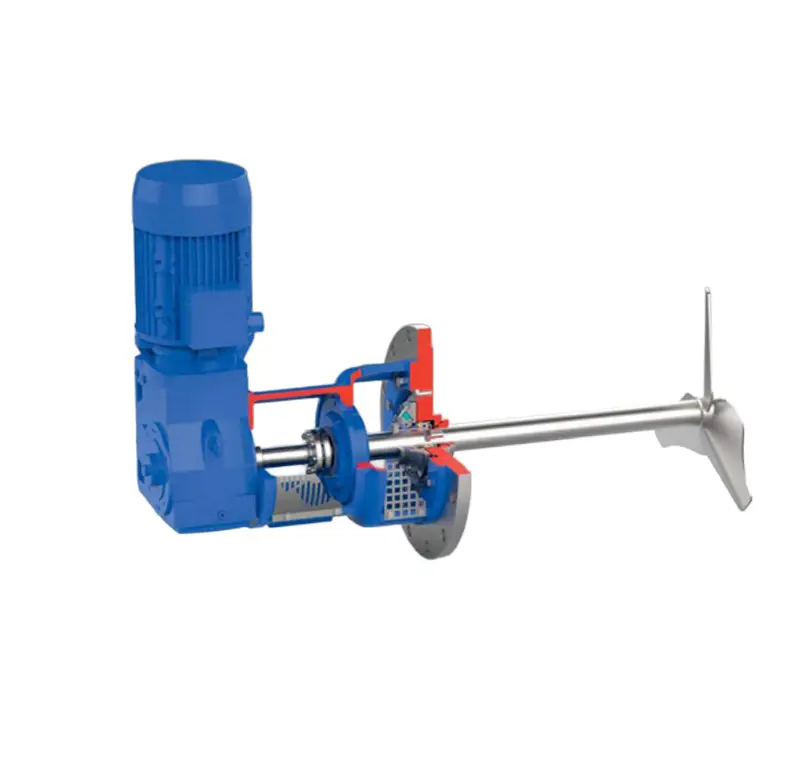
ARL Agitator
Geared Side Entry Agitator
Technical characteristics
- Power: 0,25 kW – 15 kW
- Pressure (bar): -1 to 10



Latest News
Read the other news

F.A.Q.
Interpump is a large multinational group
*Data refer to year 2025