

Industrial Agitators
Coaxial Dual Shaft Agitators
Two coaxial shafts for mixing viscous fluids and multi-phase processes
Coaxial dual shaft agitators are machines that combine two independent agitation systems on the same vertical axis, each with its own impeller, rotation speed and motor. The coaxial configuration enables simultaneous management of two distinct process functions within the same tank: bulk fluid movement along the walls and bottom, and localized action at the tank center for dispersion, emulsion or particle size reduction.
In the Interpump Process Technology range, coaxial dual shaft agitators address the needs of the most complex processes from a rheological standpoint: high-viscosity fluids, non-Newtonian products, processes in which fluid viscosity changes significantly during processing, multi-phase mixing in which components with different characteristics must be integrated homogeneously.
How dual motion works
The coaxial dual shaft agitator consists of two coaxial rotating assemblies, powered by two independent gearmotors installed on the upper tank flange. The outer shaft, generally running at reduced speed, carries a large-diameter impeller typically anchor- or helical-ribbon-shaped, often equipped with peripheral scrapers that sweep the tank walls. The inner shaft, independent of the outer one and generally running at higher speed, carries one or more central impellers of turbine, disperser or high-efficiency type.
The two shafts can rotate in the same direction or in opposite directions, depending on the required process effect. The slow rotation of the outer anchor ensures fluid movement along the walls — a critical function in viscous fluids, where traditional central impellers generate dead zones and preferential channels in peripheral areas — and keeps heat exchangers or jacketed walls clean, improving heat transfer. The rapid rotation of the central impeller acts locally on the fluid in transit, generating shear, powder dispersion or emulsion of non-miscible liquid phases.
The independence of the two motors allows the rotation speeds to be regulated separately, adapting the agitator behavior to each process phase. Typically, at the start of the cycle, outer rotation is prioritized to initiate bulk circulation; during component addition or intensive processing phases, inner rotation is activated or accelerated; in the final phase, both can be modulated to achieve the required homogeneous product.
When to select a coaxial dual shaft agitator
The coaxial dual shaft agitator is indicated when a single agitation system is not sufficient to guarantee the process outcome. Three typical situations justify its use: processing of high-viscosity fluids — creams, gels, pastes, dense products — where a single traditional agitator leaves dead zones near the tank walls; multi-phase processes in which components with widely different viscosity or density must be integrated into a homogeneous final product; jacketed thermal processes where wall scraping by the outer anchor is critical to ensure efficient heat transfer and avoid encrustation or crystallization.
Compared to single-impeller agitators — vertical, side entry or magnetic drive — the coaxial dual shaft offers radically superior process control on viscous fluids and multi-phase processing, but entails greater construction complexity, larger footprint and higher initial investment. It is therefore a solution targeted at specific processes, not a universal alternative: for standard applications with low- or medium-viscosity fluids, single-impeller configurations remain more efficient in cost-performance terms.
Related Products

No products
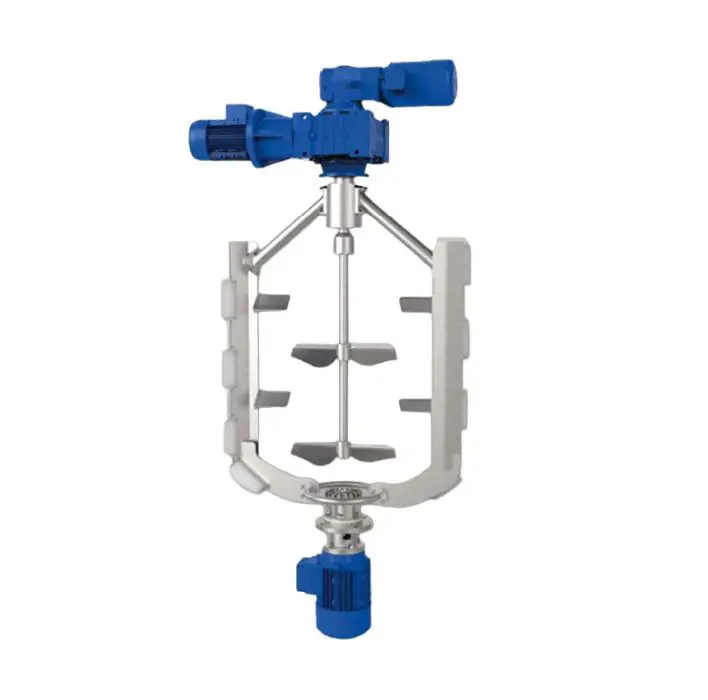
DM Agitator
Coaxial Dual Shaft Vertical
Technical characteristics
- Power: 0,25 kW – 22 kW
- Pressure (bar): -1 to 6

Areas of application


Latest News
Read the other news
F.A.Q.
Interpump is a large multinational group
*Data refer to year 2025